

by Alison Maloney
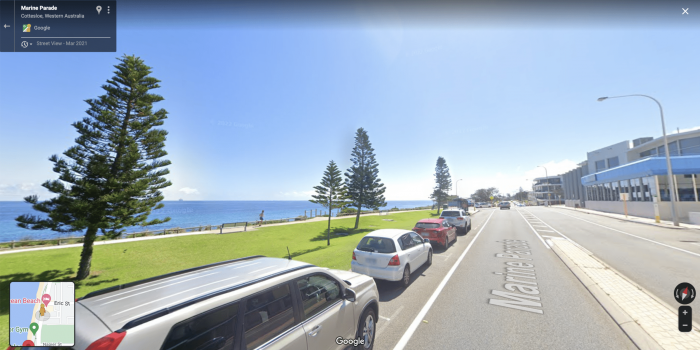
Google’s Street View celebrates its 15-year anniversary this year. It was launched in 2007 when Larry Page had the idea to capture a 360-degree view of the world. Is there anyone who wasn’t intrigued by Street View when it was released? Didn’t we all search up a few familiar addresses to take a 360-degree walk through our childhood haunts, or visit a famous landmark or two? It’s now such a normal part of our lives that it’ll soon be added to the list of things students leaving high school have never lived without. Real estate agents link to Google’s Street View to show a 360-degree view of a house before you even go there, and more and more companies are using Street View Inside to showcase their business, particularly in the hospitality industry, to attract clientele.
And Street View is only the tip of the iceberg when it comes to the affordances of 360 experiences. In 2016, StoryUP, a virtual reality company, commissioned an independent case study to test an anecdotal observation that people watch 360-degree video for longer than fixed frame video. They discovered that viewers watched more video by 28.8% and double the number of viewers watched through to the end.
Education has been dabbling with 360-degree video for some time, in some pockets more than others, and we believe it’s now an expected component for supporting learning. Because 360-degree video is recorded in all directions, learners are able to watch the video from whatever perspective they’d like. These videos are easy to navigate through dragging the video up, down or to either side, and they provide an immersive feeling that is not present in fixed frame video.
For a long time educators have struggled with the question of ‘how to offer a real-life experience to learners who are prevented from actually having that experience’. There can be many things that restrict a learner from being able to participate – an illness or disability, limitations around travel and distance, or maybe there are safety concerns with exposing learners to dangerous environments too early in their studies. Whatever the reason, 360-degree video – with its affordances of engagement, active participation and immersion – offers the next best thing; it allows educators to create content that learners can truly explore and ‘experience’, without discrimination or danger.
When discussing 360-degree video with Martin Hill, Learning and Teaching Technologist at Murdoch University in Perth, Western Australia, he commented:
“360-degree video allows students the opportunity to experience remarkably immersive video walk-/fly-throughs, being completely surrounded by video recordings of environments that one would normally only see through a keyhole. 360-degree video enables students to experience environments and scenarios that are so realistic and immersive that the old truism of being ‘the closest thing to actually being there’ is that much closer to reality.”
Martin Hill, Learning Technologist, Murdoch University Tweet
Watch a 360 degree video in Echo360 here
Our customers are using 360-degree video on their campuses in a wide range of use cases across all subject areas, such as:
- Recording and playback of protein folding mechanisms and results in virtual space
- An immersive tour of a large-scale bio-security facility
- Medical professionals and their patient care in an emergency ward
- Archaeological digs and artifacts at historical sites
- Mechanical engineering assessments
- On-site health and safety evaluations